• contact@khanhealthstrategies.com
  • 405-819-8468

From Community Health Needs Assessment to Community Impact:

Closing the Implementation Gap

Dr. Fahad F. Khan, DHA, MPH Founder & Principal, Khan Health Strategies
The challenge is no longer simply identifying need. It is closing the implementation gap between what communities tell us and what institutions actually change.
Across healthcare and public health, we have become increasingly sophisticated at identifying community needs. Hospitals conduct Community Health Needs Assessments. Health departments complete Community Health Assessments. Health plans analyze claims, utilization, disparities, social drivers of health, and geographic variation. The harder question is what happens next. Too often, the assessment is strong, the report is polished, priorities are announced – and then implementation loses momentum. Responsibility becomes diffuse. Community partners are unclear about their roles. Investments are spread across too many priorities. Measures focus more on activity than impact. NACCHO’s updated Mobilizing for Action through Planning and Partnerships (MAPP 2.0) offers a useful framework for thinking differently about that gap. MAPP 2.0 connects three phases: building the community health improvement foundation, telling the community story, and continuously improving the community. Its foundational principles emphasize continuous improvement, trusted relationships, community power, data- and community-informed action, and strategic collaboration across sectors.
In my experience, four implementation gaps matter most.

1. Move from identifying needs to making choices

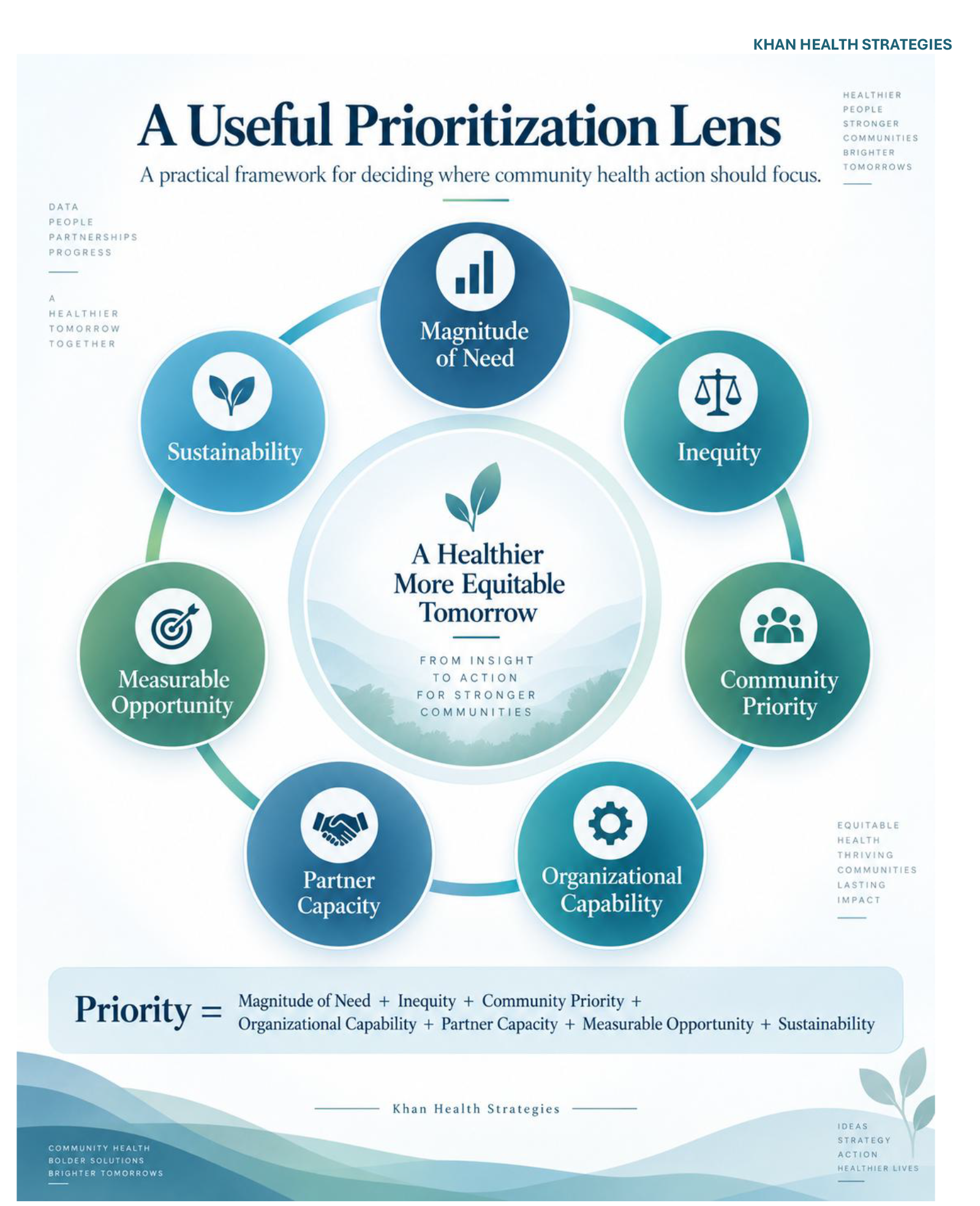
A strong assessment may identify many legitimate needs. A strong strategy cannot treat all of them as equal priorities. MAPP 2.0 brings together quantitative data, qualitative community insight, and an understanding of partner capacity. Its Community Status Assessment examines health status, inequities, social determinants, and upstream factors, while the Community Context Assessment incorporates lived experience, strengths, assets, culture, and history. The goal should be more than a list of problems. It should create a shared understanding of where coordinated action can make the greatest difference. Figure 1. KHS Community Prioritization Lens – an applied framework for moving from identified need to strategic community health priority. Framework developed by Khan Health Strategies, informed by MAPP 2.0 principles and applied experience in public health, managed care, and community-based implementation. Strategic community impact requires making choices – including deciding what not to pursue.

2. Move from community engagement to community influence

Most organizations now understand that community engagement matters. But listening is not the same as sharing influence. MAPP 2.0 places greater emphasis on power, partnership, lived experience, and the role communities play in decision-making. Its Community Partner Assessment examines not only organizational capacity, but also the collective strength of the partner network. The MAPP Power Primer goes further by emphasizing power-sharing and centering the experiences and solutions of communities most affected by inequities.
Asking communities what they need is different from giving them a meaningful role in deciding what gets prioritized, funded, implemented, and evaluated.
 

3. Move from strategy to an operating model

This may be the most common implementation gap. A priority without an accountable owner is an aspiration. A partnership without defined roles is a relationship. An investment without governance is funding – not strategy. Every major community-impact priority needs an accountable leader, defined partners, clear roles, resources, timelines, governance, shared measures, and a regular performance-review cadence. I saw this repeatedly during my years in the state government. We invested intentionally in strengthening our team’s capacity around the MAPP framework. The assessment was rarely the hardest part. The difficult work began when findings had to become priorities, priorities had to become coordinated action, and partners had to remain aligned long enough to produce measurable change. I saw the same principle again in Medicaid managed care, where I helped advance place-based Health Empowerment Zone strategies designed around locally led, data-informed priorities rather than one-size-fits-all programming. The stronger opportunity was not simply funding projects; it was building local capacity, partnerships, coordination mechanisms, and infrastructure that could outlast an individual grant or initiative.

4. Move from activity to impact

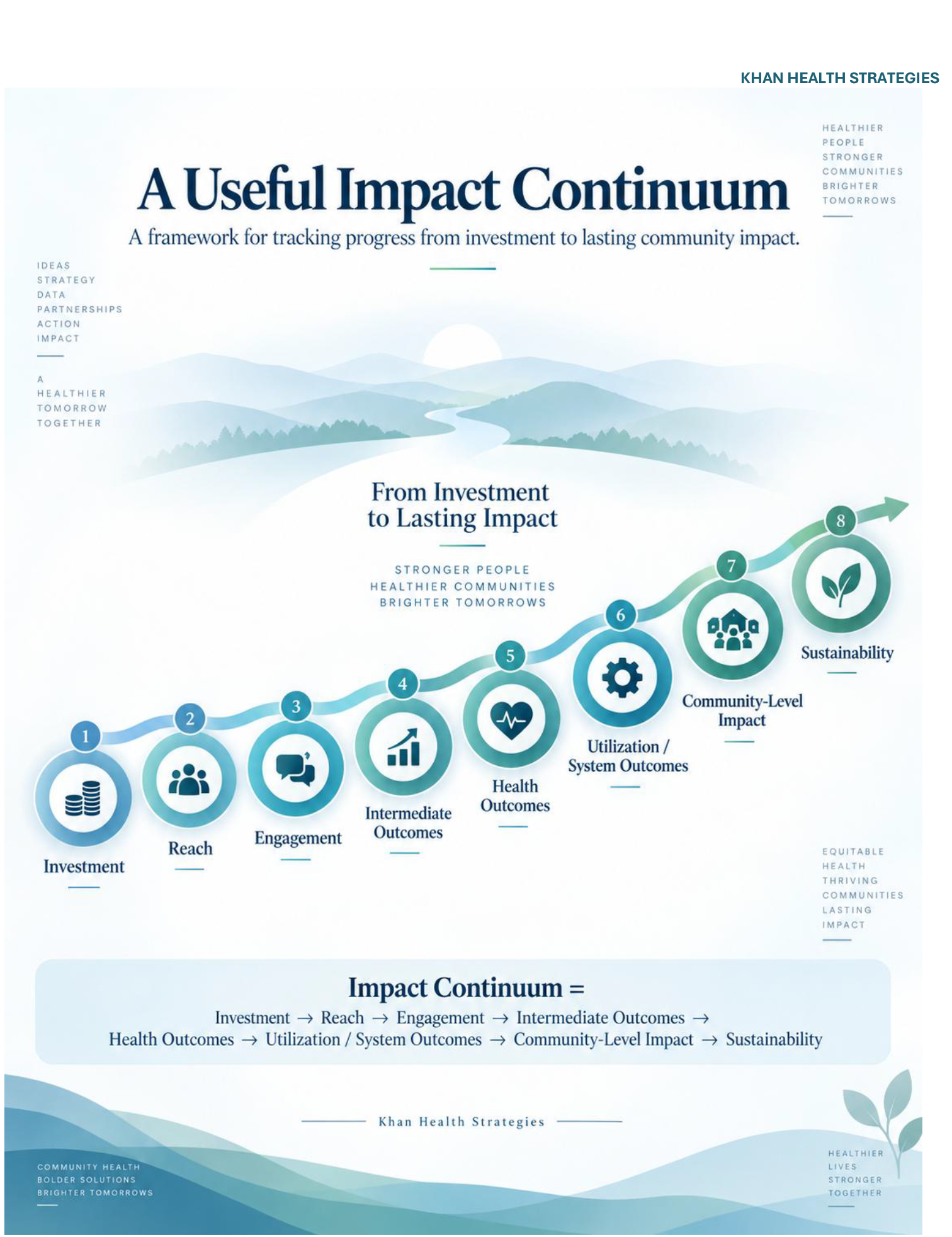
Community-impact reporting often begins with numbers such as dollars invested, people served, meals distributed, screenings completed, or referrals made. Those measures matter, but they mostly tell us what we did. MAPP 2.0 moves the process toward shared goals, long-term measures, logic models, evaluation plans, action planning, monitoring, and continuous improvement. Figure 2. KHS Community Impact Continuum – an applied framework for tracking progress from investment to sustainable community impact. Framework developed by Khan Health Strategies, informed by MAPP 2.0 principles and applied experience in evaluation, population health, managed care, and community implementation. The right measures will vary by intervention. A food-access initiative, for example, might begin by tracking enrollment and participation, but over time should also examine food security, clinical outcomes, utilization, member experience, equity, cost, and sustainability.

From assessment to impact

I think of the transition from assessment to impact as a simple cycle: ASSESS  →  PRIORITIZE  →  ALIGN  →  IMPLEMENT  →  MEASURE  →  ADAPT  →  SUSTAIN Community voice  |  Data  |  Partnership  |  Accountability
The goal of a Community Health Needs Assessment should never be the assessment itself. Its value is realized when community knowledge becomes organizational priority, priority becomes coordinated action, action becomes measurable change, and what works becomes sustainable.
Closing that implementation gap is where community benefit begins to become community impact.
 

Turning Community Priorities into Measurable Action

Khan Health Strategies works with health systems, health plans, public agencies, and community partners to move from assessment and strategy to implementation. Support can include community health assessment and prioritization, strategic planning, community investment design, partnership and governance models, implementation roadmaps, performance measurement, evaluation, and sustainability planning. If your organization is asking how to translate community needs into a focused, measurable, and sustainable impact strategy, I would welcome the opportunity to connect.

Dr. Fahad F. Khan, DHA, MPH  |  Founder & Principal, Khan Health Strategies

khanhealthstrategies.com  |  ffkhan.1978@gmail.com  |  405-819-8468


Selected Sources

National Association of County and City Health Officials (NACCHO). MAPP 2.0 User’s Handbook, Community Status Assessment, Community Partner Assessment, Community Context Assessment, and Power Primer. NACCHO MAPP 2.0

Leave a comment