- contact@khanhealthstrategies.com
- 405-819-8468

From identifying a need to changing an outcome: the work after screening is where value is created.
| The central question is no longer whether healthcare should screen for social needs. It is whether the system can reliably convert a positive screen into meaningful help – and whether we measure what happens next. |
Across health plans, health systems, primary care practices, and community partnerships, screening for food insecurity, housing instability, transportation barriers, and other health-related social needs has become increasingly normalized. That matters because social needs can determine whether a person obtains care, follows a treatment plan, manages chronic disease, or avoids preventable utilization.
Measurement has also become more formal. NCQA’s Social Need Screening and Intervention (SNS-E) measure assesses screening for food, housing, and transportation needs and whether people with a positive screen receive a corresponding intervention within 30 days. Measurement Year 2026 updated coding and data-source specifications, but the direction is unchanged: organizations are being asked not only to identify needs, but to document a response.[1]
CMS’s Accountable Health Communities (AHC) Model pushed further by testing screening, referral, navigation, and community alignment at scale. More than 1.1 million Medicare and Medicaid beneficiaries were screened, and CMS’s 2026 final evaluation reported more than $200 million in net savings, aided by reductions in high-cost, avoidable utilization.[2]
But there is an important distinction: a completed screen is evidence that a question was asked. It is not, by itself, evidence that a problem was solved.KHS Screening-to-Impact Continuum
 The farther right an organization can measure reliably, the closer it gets to understanding whether its social-needs strategy is producing value.
Provider hesitation is not always resistance to the idea that social conditions matter. Sometimes the connection to the patient’s disease journey is not obvious during a clinical encounter; in other cases, clinicians understand the connection but adding another screen to an already crowded workflow feels difficult. The practical questions are simple: Who asks? Where is it documented? Who follows up? What happens when the answer is yes?
Those concerns are legitimate. Screening without a credible response pathway can frustrate patients and clinicians alike, especially when practices do not know what resources exist, lack staff to navigate them, or never learn whether a referral led anywhere. The challenge is therefore not simply persuading clinicians to screen; it is making screening actionable.
Organizations can reduce friction by embedding screening into existing workflows, assigning clear follow-up ownership, providing reliable referral and navigation pathways, and creating feedback loops to the care team. Financial incentives and reimbursement can also help practices build the required staffing and infrastructure. Medicare’s Community Health Integration (CHI) and Principal Illness Navigation services are examples of policy beginning to recognize navigation and connection to community resources as part of care, including qualifying services furnished by auxiliary personnel such as CHWs under practitioner supervision.

CHWs are especially valuable in this ‘missing middle’ because they do more than hand someone a resource list. As trusted frontline workers, they can explain options, navigate eligibility and logistics, support self-advocacy, and stay engaged long enough for a need to be meaningfully addressed. CDC describes CHWs as trusted members of, or people with a close understanding of, the communities they serve who connect people to health and social services and help overcome barriers related to social determinants of health.[4]
Where CHWs are placed matters. Limiting them to traditional clinical settings can miss people whose lives are centered elsewhere. Embedding CHWs in primary care, FQHCs, hospitals, behavioral health settings, food access sites, shelters, schools, faith and community organizations, and other trusted locations shortens the distance between identifying a need and reaching someone who can help resolve it.
That does not mean every setting needs an isolated CHW program. Communities need a connected workforce and referral infrastructure so people can enter through multiple doors and still reach coordinated support. CHWs can bridge clinical care and community resources when backed by shared workflows, supervision, data, and sustainable financing rather than short-term grants alone.
Care hub models offer one way to organize that infrastructure. In the Pathways Community HUB Institute (PCHI) model, a HUB coordinates community-based organizations and care coordination agencies that employ CHWs. CHWs identify medical, social, and behavioral risks, address them through standardized Pathways, and document whether defined outcomes are achieved. The HUB can contract with health plans, hospitals, government, and other funders and distribute payments across participating organizations.[5]
The key design principle is a shift from paying only for activity to paying for verified progress and outcomes. PCHI links a substantial portion of payment to successfully closed Pathways, making CBOs accountable partners rather than passive referral destinations and giving purchasers clearer evidence of what they are buying and whether needs are actually being resolved.[6]
Not every community needs the same model, but the principle is transferable: health plans and health systems can purchase community-based care coordination in ways that build local capacity, reward successful resolution, and give clinical and community partners a clearer picture of what happened after referral.
The goal is not to commercialize social need. It is to stop expecting community organizations to solve complex needs indefinitely without durable financing. If the infrastructure disappears when a grant ends, the referral pathway was never truly closed.
Organizations may therefore need business-model support as much as program design: assessing whether CHW workflows are ready for contracting; defining deliverable services and outcomes; identifying payer or provider partners; building the financial case; designing performance measures; establishing referral and data-sharing workflows; and selecting appropriate reimbursement or outcome-based payment models. For firms such as Khan Health Strategies, helping organizations connect mission, measurable impact, and sustainable revenue is a natural extension of implementation and evaluation work.
For nonprofits, public agencies, and community organizations, the opportunity can be broader than another grant. Proven community capability may become earned revenue through payer contracts, hospital partnerships, value-based arrangements, or compliant clinical-community models. Done well, that gives CBOs a more stable funding base, strengthens CHW employment, gives providers credible places to refer patients, and lets healthcare purchasers tie investment to measurable results.
Medicare’s CHI services create another financing pathway. CHI recognizes person-centered planning, care coordination, self-advocacy support, and access to community resources when health-related social needs interfere with diagnosis or treatment. An eligible physician or practitioner bills for the service, while qualified auxiliary personnel may furnish it under applicable Medicare requirements. A nonprofit or CBO generally cannot simply submit a CHI claim independently, but it may partner with billing practitioners so trained CHWs or other qualified personnel provide the community-facing work within a compliant care model.[7]
The Pathways Community HUB model illustrates the complementary outcome-based approach: participating agencies employ CHWs, standardized Pathways document progress, and payment is tied in meaningful part to completed outcomes. This creates a route for CBOs and CHW organizations to contract with healthcare purchasers for accountable community care.[8]
Together, these approaches show how follow-through infrastructure can also support sustainability. Instead of relying only on short-term grants or uncompensated referral activity, community organizations can increasingly position defined care-coordination services as funded work when health plans, hospitals, ACOs, and other purchasers are willing to pay for measurable outcomes.
A stronger operating model: from screening to accountable community action
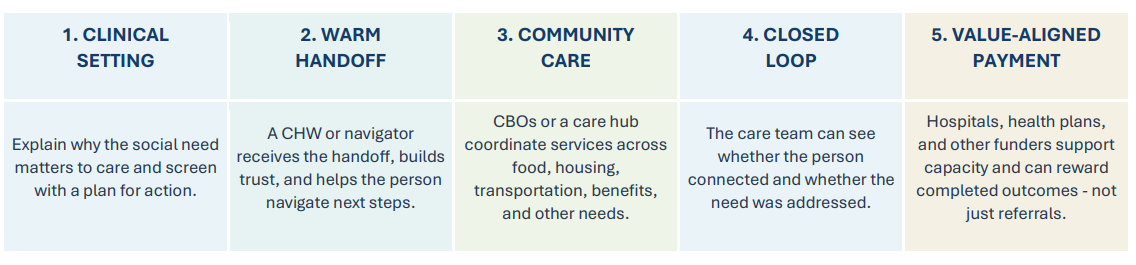

Healthcare organizations often know a referral was sent but not whether the CBO received it, the person engaged, or the need was addressed. Closed-loop platforms can help, but technology alone cannot create shared workflows, common definitions, timely follow-up, or service capacity; those are operating-model issues.
The feedback loop also matters to clinicians. If they repeatedly screen and refer without learning what happened, social-needs work can feel disconnected from care. With appropriate privacy, consent, and data-sharing practices, the care team should receive enough information to understand whether the intervention supported the treatment plan and what barriers remain.
The strongest programs eventually ask whether addressing the need changed something that matters: medication adherence, prenatal care, diabetes management, avoidable ED use, readmissions, member experience, total cost, or another outcome appropriate to the population. Not every intervention will produce short-term medical ROI, and not every meaningful outcome is financial, but organizations should define what success is expected to look like.
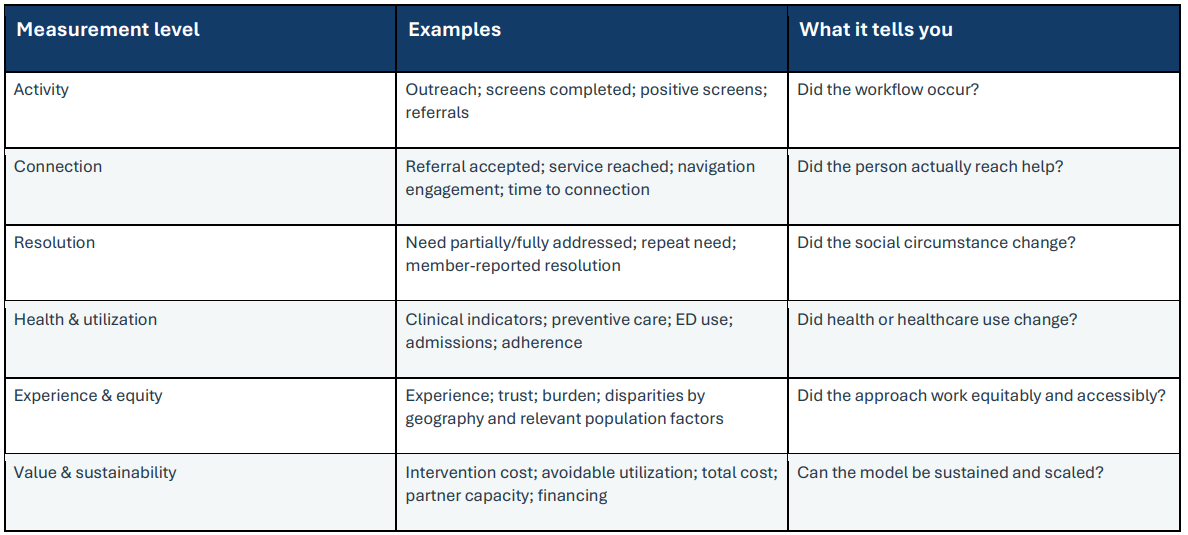
A useful measurement strategy separates activity from connection, resolution, outcomes, experience, equity, and sustainability. The exact measures will vary by population and intervention, but the framework below helps prevent organizations from declaring success too early.
Screening remains important because organizations cannot act on needs they never identify. But as screening becomes routine, the strategic challenge shifts: the differentiator will be connecting clinical care, health plans, community organizations, technology, navigation, financing, and measurement into a system that reliably moves people from identified need to meaningful result.
That means treating social-needs work as an operating model, not a questionnaire – one that addresses outreach, workflow, community capacity, data exchange, accountability, evaluation, and sustainable financing, and is willing to discover that the real problem may not be where the dashboard first suggests.
The model depends on providers who can identify needs without disrupting care, CHWs who engage people in trusted settings, CBOs with capacity to deliver help, hub or network structures that coordinate across organizations, financing that rewards meaningful outcomes, and data that closes the loop. Screening is the front door; the real work is building what comes next.
The goal is not to become better at documenting need. The goal is to become better at responding to it.| KHS Perspective
Khan Health Strategies focuses on helping healthcare and public-sector organizations connect strategy, implementation, measurement, and partnership design. KHS Insights explores practical questions at the intersection of population health, Medicaid, healthcare transformation, evaluation, and community impact. |


Leave a comment