- contact@khanhealthstrategies.com
- 405-819-8468
A population-health perspective on implementation, provider education, community outreach, coverage preservation, and the downstream impact on hospitals and rural communities.
By Dr. Fahad Khan, DHA, MPH | Khan Health Strategies | October 2026For some time, I have been raising concerns about the implementation of Medicaid work requirements. Beginning January 1, 2027, federal law will require many states to condition Medicaid eligibility for certain adults on meeting work or other qualifying activity requirements, unless an exclusion or exception applies. Some states have implemented or are implementing the requirements earlier. Nebraska began enforcement on May 1, 2026. [1]
My concern has never been limited to the policy itself. It has been about what happens between policy and implementation.
And we already have lessons from the past.
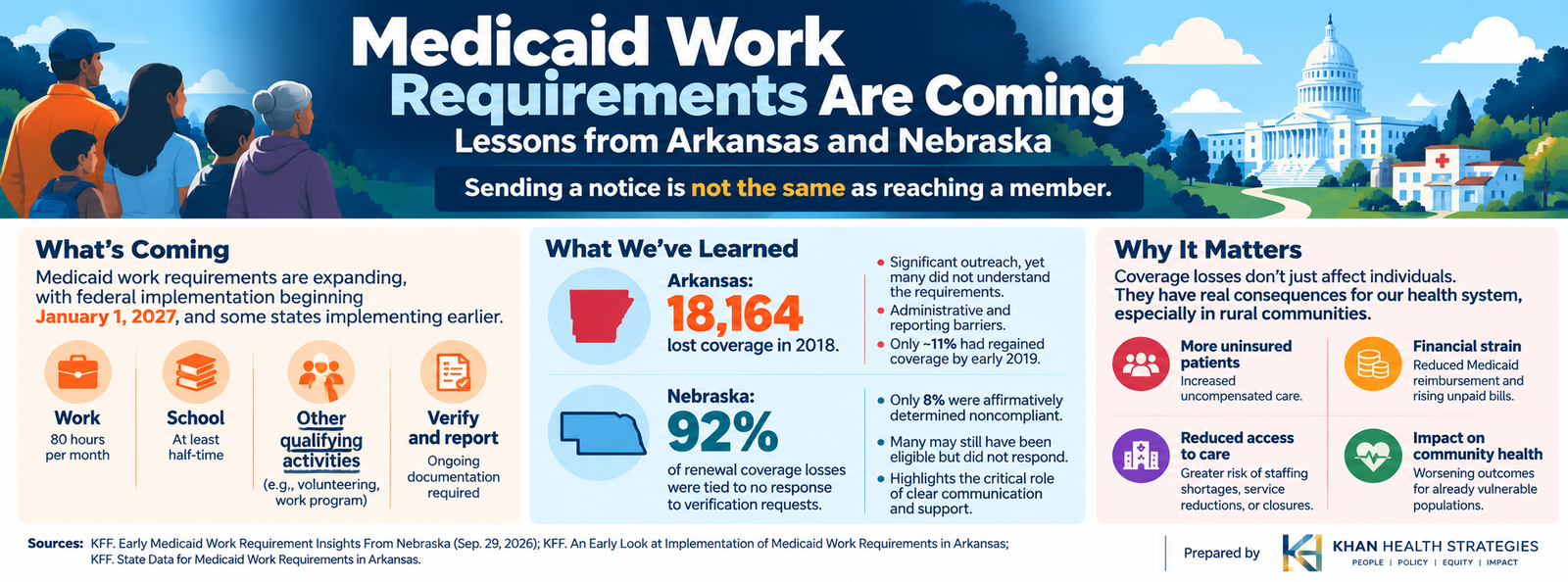
Arkansas showed us what can go wrongArkansas was the first state to implement Medicaid work and reporting requirements in 2018. A total of 18,164 people lost Medicaid coverage that year for failure to meet the work and reporting requirements, and only about 11% had regained Medicaid coverage by early 2019. [2]
What is especially important is that Arkansas did not simply have an “outreach problem” in the traditional sense.
There was substantial outreach by the state, health plans, providers, and beneficiary advocates. Yet many Medicaid members still were not successfully reached or did not fully understand what they were required to do. KFF documented confusing notices, online account complexity, technical and literacy barriers, and people who could qualify for an exemption but were not identified through state data matching. [3]
| Sending a notice is not the same as reaching a member. |
Nebraska’s early experience is now reinforcing many of those concerns. Among people subject to the new requirements at renewal, 7% lost Medicaid coverage. Of the 533 people who lost coverage, 92% did not respond to verification requests; only 8% were affirmatively determined to be noncompliant. [1]
Among new applicants subject to the requirements, 14% were denied. Of those denials, 84% resulted from non-response to requests for additional information, while only 16% were affirmatively found noncompliant. [1]
That distinction should get our attention. A person losing Medicaid because they did not complete a verification process is not necessarily the same thing as a person who is unwilling to work or who fails to meet the underlying requirement.
They may already be working. They may qualify for an exclusion. They may have moved, changed phone numbers, or not understood the notice. They may have limited internet access, unstable housing, transportation challenges, caregiving responsibilities, or behavioral health needs. The implementation challenge is therefore much bigger than simply sending letters, making automated calls, or placing messages in a member portal.
Figure 1. Medicaid work requirements: lessons from Arkansas and Nebraska, potential impacts, and an implementation framework. Preparedby Khan Health Strategies.
Provider education cannot be treated as a secondary communication strategy. Under the new Medicaid work requirements, clinicians may become part of the eligibility infrastructure itself.
A 2026 JAMA Internal Medicine Viewpoint, “Medicaid Work Requirements—The Physician as Arbiter,” illustrates the practical dilemma: clinicians may be asked to certify that a patient is medically frail or has a disabling condition that qualifies for an exclusion. In those situations, a clinical encounter can directly affect whether a patient retains Medicaid coverage. [4]
That changes the implementation equation. Providers need to understand who may be subject to the requirements, what exclusions apply, what documentation is needed, how certification should occur, and where patients can obtain assistance. Without that education, a patient who legitimately qualifies for an exclusion could still lose coverage because neither the patient nor the clinician recognized what needed to happen.
It also raises an equity concern. A patient with an established primary care relationship may have a much easier path to obtaining documentation than someone who lives in a rural community, lacks transportation, has intermittent coverage, has behavioral health needs, or does not have a regular source of care. The people most likely to need help navigating an exclusion may also be among those least able to navigate the process on their own.
This is why provider engagement must begin before implementation, not after coverage losses appear in the data. Medicaid agencies, managed care organizations, health systems, medical societies, federally qualified health centers, rural health clinics, behavioral health providers, pharmacists, and other clinical partners should receive practical guidance and workflows. Providers should not discover their role only when a patient arrives with a form in hand.
Federal implementation guidance already recognizes the need for outreach not only to beneficiaries, but also to providers and managed care plans. [5]
The same is true for community-based organizations. Community health workers, food banks, faith organizations, libraries, schools, workforce organizations, shelters, social service agencies, and other trusted community partners often have relationships with people that healthcare institutions simply do not.
| Meet members where they are — not where the system wishes they were. |
A comprehensive outreach strategy should combine traditional communication with trusted local touchpoints, data matching, real-time identification of people at risk, navigator and CHW support, multilingual communication, provider engagement, and rapid assistance before coverage is terminated.
The goal should not simply be to document that outreach occurred. The goal should be to determine whether the member understood what was required and had a reasonable opportunity to complete it.
There is another important dimension to this discussion: providers and hospitals absorb the downstream consequences of coverage loss.
When Medicaid coverage is lost, healthcare needs do not disappear. People still become sick. They still need medications, behavioral health services, maternity care, emergency services, and hospital care. But when fewer patients have coverage, providers may see more uncompensated care and unpaid bills.
That is particularly concerning for rural hospitals. KFF found that 44% of rural hospitals had negative operating margins in 2023, compared with 35% of urban hospitals; the share was even higher in the most remote rural areas. [6] Medicaid also plays an outsized role in rural healthcare, covering one in four rural adults, nearly half of rural births, and about one-fifth of inpatient discharges. [7]
So even relatively modest increases in the uninsured population can have consequences that extend beyond an individual beneficiary: more uncompensated care, greater financial pressure on clinics and hospitals, difficulty maintaining service lines, and potentially reduced access to care in communities where alternatives may already be limited.
Medicaid work requirements alone do not determine whether a rural hospital survives. Rural hospital finances are shaped by patient volume, workforce shortages, payer mix, fixed operating costs, demographics, reimbursement, and many other factors. But avoidable coverage losses can add another layer of pressure to institutions already operating on narrow margins.
For Oklahoma, this is not an abstract concern. America’s Health Rankings placed Oklahoma 45th overall in its 2025 Annual Report and 48th in the Clinical Care category; more than one-third of the state’s population is rural. [8] A state already facing significant health and access challenges can ill afford preventable coverage losses that increase the number of uninsured residents and shift additional uncompensated care onto hospitals and other safety-net providers.
If people who remain eligible lose Medicaid because of administrative barriers rather than true ineligibility, the effects can ripple through families, providers, rural communities, and local economies. That would be a setback at a time when Oklahoma should be strengthening coverage continuity, access to care, and population health.
Arkansas gave us an important precedent. Nebraska is giving us contemporary data. We should use both.
As states, Medicaid agencies, managed care organizations, providers, and community partners prepare for broader implementation, success should not be measured simply by whether notices were mailed or systems were operational.
The lesson from Arkansas and the early experience in Nebraska is straightforward: a compliance strategy alone will not be enough.
| We need a population health strategy. |
One that combines policy implementation with provider education, community partnerships, data, trusted messengers, and proactive outreach.
Because ultimately, sending a notice is not the same as reaching a member. And if we already know where the gaps are likely to occur, we should design the system to close those gaps before people lose coverage.


Leave a comment